Open Today Dubai: 10am - 6pm | Ramallah: 10am - 6pm
Open Today Dubai: 10am - 6pm | Ramallah: 10am - 6pm
4 April – 30 June, 2026
Elusive Territories
Group Exhibition
Location: Dubai
In these times of turmoil when many people are dispossessed from their homes in the region, Elusive Territories brings together fifteen prominent Palestinian artists whose work examines the relationship between exile, memory, and homeland. These three dynamics constantly engage with one another in connection with the homeland at a critical time.
In exile, memory is a sanctuary to which Hosni Radwan retreats, a place where he is still surrounded by familiar landscapes: The Road to Jericho and all the scenery along it. Memory also brings moments of joy, as in Samia Halaby’s Evening in the Desert (2019). Her work brings about the serenity of witnessing the sunset in the Jordan Valley as it sinks behind the rocky hills of Palestine. Yet memory haunts as well, Bashir Makhoul weaves, in Skein (2023), dense, layered patterns reflecting what it means to be exiled yet still connected to a place he carries within him.
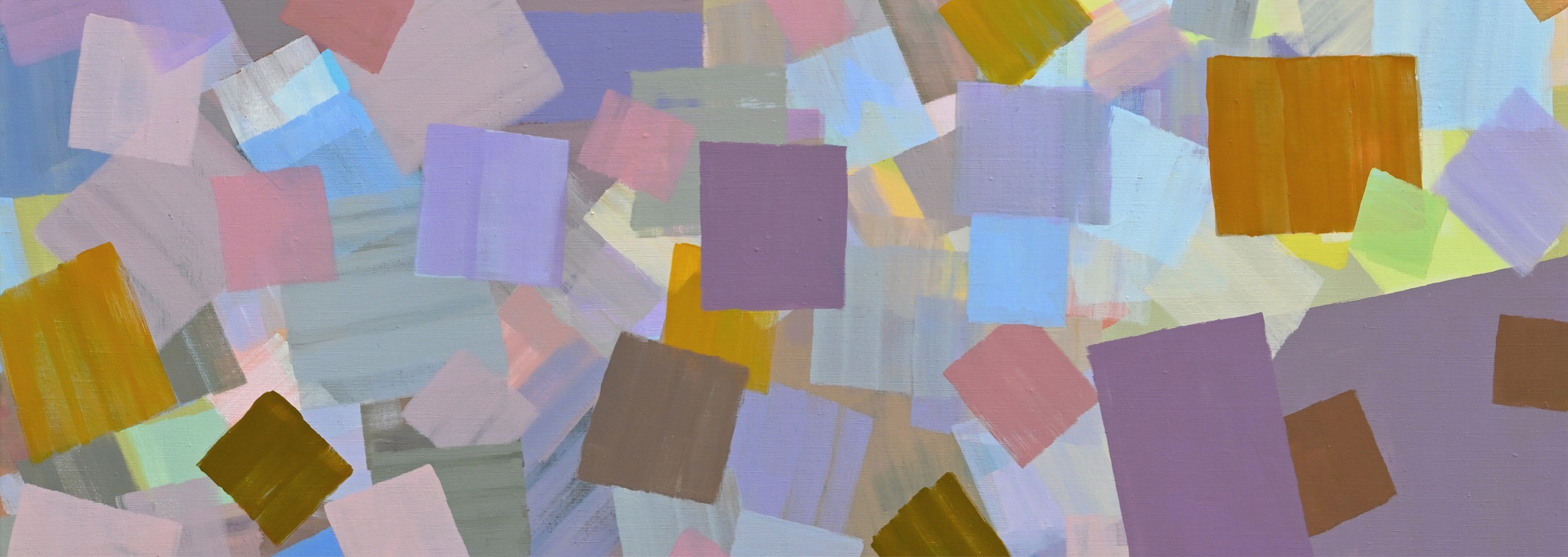
Mohammed Joha’s Houseless (2020) engages directly with home and exile. His body of work contends with the physicality of the refugee camp, while also serving as a metaphor for exile as an architecture of rupture, defining the refugee’s constant state of displacement. In contrast, Kamal Boullata’s Quartet Opus (1994) composes homeland in musical metaphors. Through abstraction, the Dome of the Rock in Jerusalem, the beloved center of his childhood, transforms into verses of music. Geometric coloured shapes advance and recede like the flow of a musical piece taking visual form. Sliman Mansour’s unusual illustration of Arabic calligraphy titled Letter Y (2009) offers uncommon experimentation by the artists in abstraction, where the Arabic letter ي (Y) takes center stage against a bright orange background, turning language into pure visual presence. Meanwhile, Samir Salameh’s Untitled (2000) abstracts the homeland’s warmth. Its red hues give form to the feelings that surfaced upon his return to Palestine after a long exile.
Ruba Salameh seeks filiation and meaning amid a lingering sense of loss and powerlessness, finding transformative moments in history that resonate in the present. Her Composition (2020) becomes a way to navigate and reconstruct what has been forcibly erased. For Nabil Anani, paradise was lost but can be retrieved. He depicts a past that is not only remembered, but also walked toward as a tangible future. His recent series using mixed media of dried seeds and natural materials on canvas, envisions a free homeland, a nature thriving without occupation, a utopian Palestine painted in colour and form. Like Anani, Rana Samara uses bright colours to define her landscapes. Trees grow in all directions, defying two-dimensional logic and gravity, reflecting something closer to the eye of a child. Vera Tamari’s rare collage piece brings the nostalgic atmosphere of summer evenings in Palestine, capturing light and stillness in delicate composition. Khaled Hourani’s Untitled (2007), depicts shadows of the Old City of Jerusalem’s traditional architecture, a place of central importance in the heart of Palestinians, yet difficult to access under Israeli military rule.
Yet not all visions are utopian, Benji Boyadgian explores the imperfections and disorientation in Disoriented Disposition (2020), while Yazan Abu Salameh’s Shelter (2021) reflects a reality of the growing presence of concrete in Palestine, as natural spaces shrink and military structures multiply within a continuous colonial reality. In Resilience (2000), Tayseer Barakat explores individual narratives from the homeland in relation to identity, the stories of ordinary Palestinians who resist, who are displaced, martyred, imprisoned, or who simply dream of an ordinary life.
Throughout the exhibition, elusive yet persistent glimpses of an absent homeland emerge from between the cracks of the abstraction. For these artists, abstraction becomes a tool for piecing together fragments of Palestine, in an ongoing process of identity formation journey.
Participating artists:
Yazan Abu Salameh, Nabil Anani, Tayseer Barakat, Kamal Boullata, Benji Boyadgian, Samia Halaby, Khaled Hourani, Mohammed Joha, Bashir Makhoul, Sliman Mansour, Hosni Radwan, Rana Samara, Ruba Salameh, Samir Salameh, and Vera Tamari.